
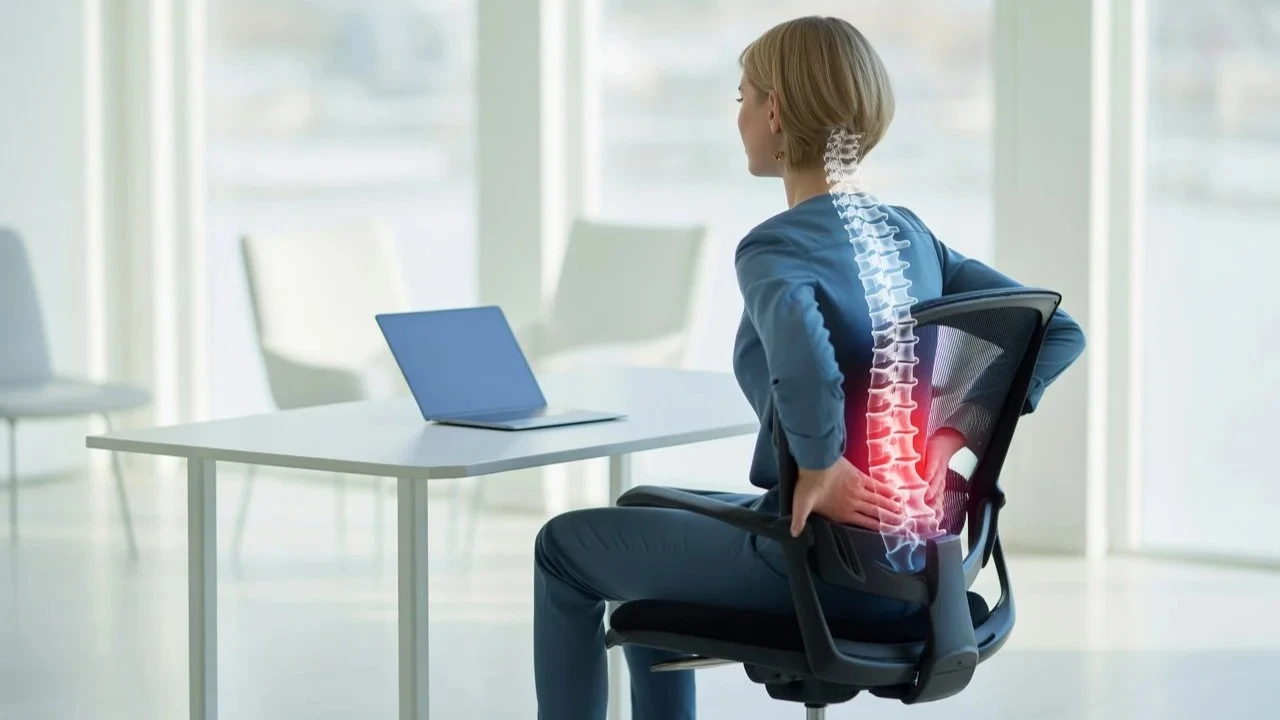
Office Neck Pain – Desk setups get blamed way too often.
If your neck feels like it’s auditioning for The Exorcist remake and you’ve just spent another hour adjusting your chair in search of ergonomic nirvana — this one’s for you. Let’s cut through the posture myths, overpriced chair marketing, and pseudo-science “desk hacks” — to uncover what actually helps your neck and back pain.
I’ve done the hard yards scouring the evidence so you just need to stick with the nuggets of gold below.
Spoiler: it’s not your $1500 ergonomic status throne.
1. The Myth of the Perfect Posture
We’ve been told there’s one perfect way to sit — straight back, shoulders down, monitor at eye level.
But if posture was the answer, no one would still have pain. Well at least the ones who’ve spent money having someone like myself get the measuring tape out and tweak their chair.
The real problem isn’t your posture — it’s your stillness.
Various reviews have found that ergonomic programs and intereventions have pretty poor evidence and don’t reduce new neck pain at all (Sterling et al., 2019).
Things haven’t improved much since a review in 2001 advised us that if we want to prevent neck or back pain, lumbar supports, education and ergonomics just can’t get near the results of exercise (Linton and Tulder, 2001).
Key takeaway: Strength beats seat height. Every. Time.
“There’s no perfect posture — only better movement.”
2. Ergonomic Chairs: Comfort ≠ Health
The ergonomic chair industry is basically the skincare aisle of the office world — full of promises, endorsements, and placebo effects. Office neck pain is booming so it’s great for manufacturers.
Most research shows no meaningful long-term benefit from fancy setups or pricey chairs. Comfort? Sure. But comfort doesn’t equal health.
If it did, I’d be filming this from a rose-petal bath, eating dark chocolate coffee beans, and somehow have a six-pack.
Office neck pain truth? Your Slouchmaster Pro 3000 can’t undo eight hours of stillness.
3. The Real Problem: Inactivity
One in five adults worldwide is physically inactive. In developed countries — make that one in four.
(Dumith et al., 2011)
It starts early. Kids who move less grow into adults with weaker bones, lower self-esteem, and higher cardiovascular risk (Dietz, 1998; Mavrovouniotis, 2012).
When you sit still, your body’s energy use drops below 1.5 METs — basically energy-saving mode for humans.
Prolonged sitting → lower energy use → insufficient stimulation for the body to function well
4. Sitting Too Long: The Dose–Response Problem
Sedentary time is dose-dependent — the more you sit, the greater your risk of dying from… well, everything.
(Wu et al., 2023)
Even regular exercisers aren’t off the hook. Sitting too long increases mortality risk independent of exercise (Katzmarzyk et al., 2009).
After about 40 minutes, postural muscles fatigue; after 2 hours, performance drops and discomfort spikes. (Baker et al., 2018; Falck et al., 2017)
Combine sitting + screens + snacks = the worst combo. (Park et al., 2020)
Yes, those lime and chilli tortilla chips are delicious — and damning.
5. Standing Desks: Overrated but Useful
If sitting is bad, standing must be the answer — right? Wrong.
Standing all day just swaps one discomfort for another. Two hours of standing work increased leg and back pain, slowed reaction time, and annoyed participants (Baker et al., 2018).
Some reviews show sit–stand desks may help some users with low back pain (Agarwal et al., 2018), but there’s no universal magic ratio.
The trick: Alternate between sitting, standing, and moving.
6. The Real Fix: Movement & Microbreaks
Here’s where we finally get traction.
Taking short movement-based microbreaks each hour — even just chair squats or a brisk walk — reduces stress and fatigue (Mainsbridge et al., 2020).
Standing or stretching five minutes every 40 minutes offsets muscle fatigue (Ding et al., 2020).
Interrupting sitting improves focus and mental sharpness (Thorp et al., 2014; Wennberg et al., 2016; Faber et al., 2012).
My point is – try movement snacks every 35 minutes.
Set an online egg timer, stand, stretch, breathe — repeat.
7. Strength Wins: The Evidence for Exercise
The most powerful solution for neck and back pain? Strength. Even for office neck pain.
Workplace-based strengthening of the neck and shoulders has strong evidence for pain reduction and better quality of life (Sterling et al., 2019).
Consistency matters — stop training, and benefits fade.
So instead of chasing posture perfection, do a few days per week of targeted strengthening.
Try my Neck Strength Basics Routine to start.
8. The Bottom Line
Let’s recap for office neck pain (and back pain):
- No perfect posture — variety wins.
- Ergonomic setups don’t prevent pain — movement does.
- Sitting and standing both cause issues — alternation helps.
- Microbreaks + Strength Training = Long-Term Relief.
Your body isn’t built for stillness. It’s built for movement. So think Movement First.
Next time you’re tempted to buy a new chair, maybe buy a set of resistance bands instead — your neck (and wallet) will thank you.
Stuart Cox.