
Neck Pain Serious Pathology – Red Flags Of The Spine 2025 update
We’re all aware of red flags – men that have plaid sheets; flattering private messages from an exotic females with usernames that end in a bunch of numbers; or maybe “life coaches” who look unable to grow a prepubescent mustache.
What about Back Pain Red Flags? Neck pain red flags. What are they? What do they mean? What is their significance?
As a veteran Physiotherapist and progressive educator and consultant, I’m all about the evidence when it comes to back and neck pain, and today it’s time for the RED FLAGS.
This blog will go into the latest evidence and I have even made you a completely free guide that uses this evidence to work out whether you have significant signs of serious pathology of the spine. Sounds good?
Ok, neck and back pain is everywhere and people are in serious pain.
But first of all they want to know if it’s not a sign of something far more sinister.
This article could save yours or someone else’s life. It isn’t here to alarm you but rather to present the facts that show that while in some cases spinal pain can be very serious; the bulk of back and neck pain is most likely not from serious pathology.
You might be someone with back or neck pain right now or perhaps someone who is in the health game and wants to know the actual data on these red flags rather than just be told by an old colleague that he knows best and this is what he always asks and has done since 1973.
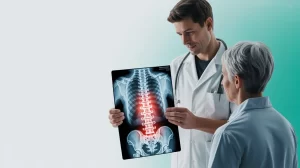
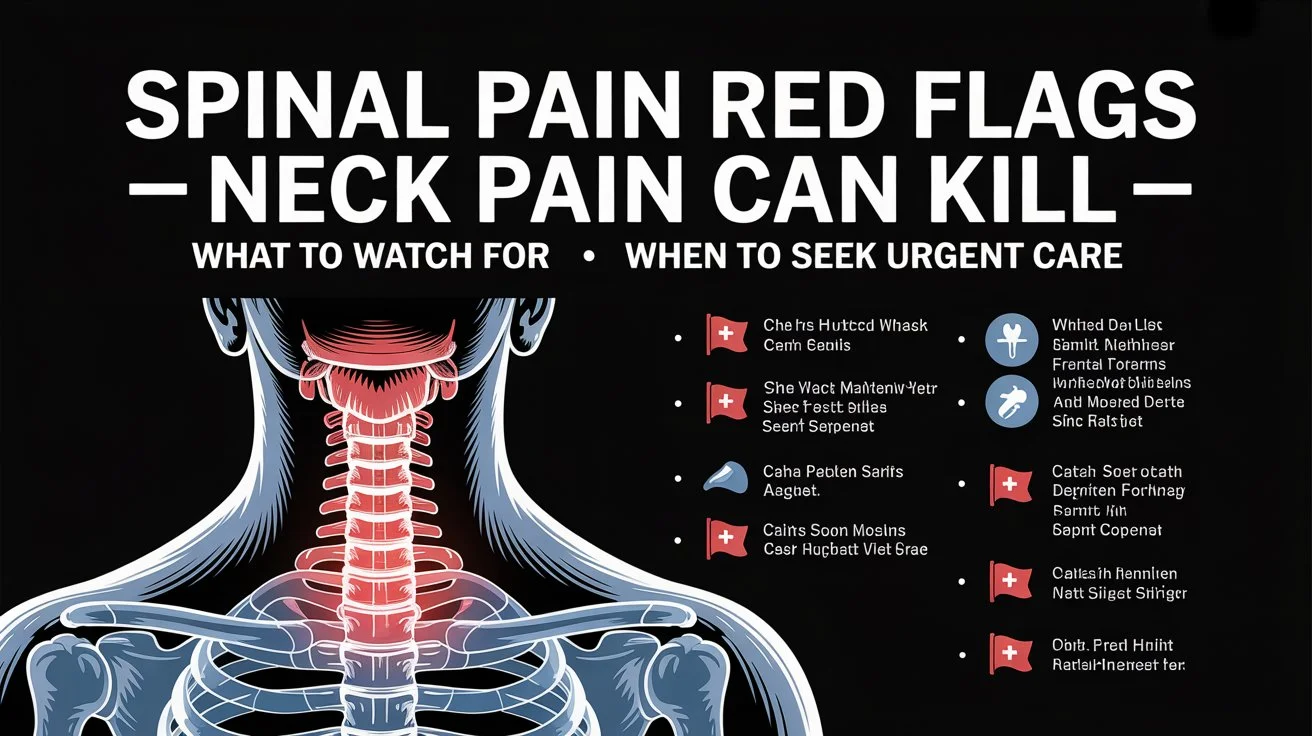
Back or neck pain can be the sign of serious medical issues. Neck pain serious pathology can be things like fractures, cancer, kidney infections or even a burst appendix.
So when dealing with people with spinal pain we must consider these things every time,yet many clinicians do not understand the risks fully and fail to ask appropriate questions to decide whether there is a major risk of serious pathology of the spine.
Traditionally Doctors like to think they are the only ones to have the skills to accurately highlight symptoms that require further investigation, but the fact is that red flag questions used by Doctors remain largely not backed up by evidence (Verhagen et al., 2016).
Even more concerning is that many Doctors are found to ignore the guidelines set by the researchers, and send people for lots of unnecessary scans of the spine. This in turn can then lead us down a path of unnecessary radiation, stress, fear, inappropriate treatments and even surgeries that we don’t need. It’s one of the reasons I’m on this mission to do something to address this problem.
But first let’s talk about the serious stuff that can cause neck or back pain:
The Red Flag Risk Data (as presenting to Medical Facilities) :
The way I’ll do this is to tell you
- What the pathology is
- Typical symptoms and signs from the research
- Prevalence – i.e the percentage of people in a certain population that test positive for the condition
Please note these percentages are from studies coming from different clinical settings. So the higher percentages usually come from back pain presentations in Emergency or Specialist Back clinics whereas the lower percentage findings invariably come from Primary care – i.e. family/general practitioner/Physiotherapy clinic settings.
Think of it like this, the back specialist who only sees chronic back pain patients and complex cases is far more likely to see someone with cancer of the spine rather than your local family doctor who is dealing with runny noses and toenail fungus.
The Neck Pain Serious Pathology Data
Neck pain serious pathology causes are more poorly researched and understood than those for the lower back and as a result a lot of the considerations and guidelines are merely adapted from low back pain risk studies.
Some may call this lazy extrapolation, and is strangely ironic given that Doctors and academics get quite upset when influencers give far too much weight to some research trial done in a remote location where people grew an extra muscle after consuming a diet of raw Armadillo carcasses.
If you’ve got some spare research grant dollars to spend, maybe start here (ahem, Bill and Melinda).
For right now though, here’s the best I could find in a caffeine-fuelled marathon.
Once again, these are the most recent estimates on prevalence in the total population in or a specific subgroup.
Spinal Malignancy (Cancer)
Neck cancer can impact any bone, soft tissue or nerve structures in the neck. They can be a primary cancer or a secondary stemming from somewhere else in the body.
Symptoms and signs to look for can include:
- History of any type of Cancer
- Significant unexplained weight loss
- Pain at night when resting
- Being over 60 years of age
Neck cancers represent <10% of all spinal metastases, so we’re looking at very low percentages here like fractions of a single percent prevalence (e.g. 0.08%) in all clinical settings (Wewel & O’Toole, 2020).
Neck Fracture
Neck fractures are a big deal due to the risk of spinal cord damage so this is why whenever there is trauma to the neck and head a scan is often done routinely to eliminate serious pathologies, especially when someone has had a traumatic incident like a car accident, fall or sporting injury.
Signs and symptoms of note are:
- Major or significant trauma (e.g. fall >1 m or 5 stairs, vehicle accident, blunt trauma)
- History of previous osteoporotic fractures
- Use of steroids or immunosuppressive drugs > 3 months
Prevalence – 4 – 5.4% of a population of trauma patients (Passias et al., 2018)
World age-adjusted incidence rate of 10.4/100,000 person-years (Utheim et al., 2022)
Overall incidence rate 5.2/100,000 person-years at risk in the US (Turner et al., 2022)
Please note, Person-years is a common incidence rate term that reflects how long the participants were in a study and how many people were in the study.
Degenerative Cervical Myelopathy (Spinal Cord Compression)
– think of not enough space for the spinal cord due to age-related changes
- Typically symptoms include (neck or limb pain, weakness, sensory loss, loss of dexterity, tingling sensation, imbalance, falls, and autonomic dysfunction like heart rate, blood pressure and digestion issues)
Prevalence is estimated as 2.3% of total population (Smith et al., 2021)
Nerve Radiculopathy (Nerve Root Pathology)
Symptoms include:
- Loss of power or sensation changes in an arm or both arms
Prevalence – 1.14 – 1.31% of population (Mansfield et al., 2020)
Cervical Artery Pathology
This means this very important vessel that lies in the neck vertebrae has some type of issue:
The three most common symptoms include: dizziness/vertigo, headache and neck pain.
Incidence rate – 2.97 cases per 100000 people per year (Béjot et al., 2014)
Infection
Can be bacterial, fungus or viral affecting the spinal cord, the vertebrae or the tissues surrounding. It can be caused by blood infections, trauma, it may have spread from other parts of the body or could be the result of a surgical procedure.
Signs and symptoms to consider are:
- Fever or chills
- Pain at night
- Recent infection history
- Use of steroids or immunosuppressors > 3 months (people with immune system disorders are more at risk)
- IV drug usage
One significant study that stated 2.2 cases of infection per 100000 per year for the whole spine; of this tiny fraction only 11% of these were in the cervical spine (Tsantes et al., 2020)
Atlantoaxial subluxation (First vertebrae instability)
Is when your first neck vertebrae is looser than it should be and has potential to pop in and out! Yikes.
What are some of the signs and symptoms?
Neck pain and stiffness, muscle spasticity, sensation and weakness in the head, neck or arms; breathing problems; dizziness/vertigo, headache or even quadriplegia symptoms.
Atlantoaxial subluxation was found to have a highly variable prevalence of 4.6 – 40% in Rheumatoid Arthritis sufferers indicating more research is needed (Laiho et al., 2002) (Le Quellec et al., 2023).
Another recent study found that 7.2% of atlantoaxial instability cases reported are people with Down’s Syndrome (Merckling et al., 2024). So if you have either of these two conditions then your risks are significantly higher.
Cervical structural abnormality / deformity
Is when you have some malformation of the spine that is significant enough to cause issues.
Signs of this can include pain; neurological deterioration, and difficulty with horizontal gaze, dysphagia (trouble swallowing), and dyspnea (breathing difficulty).
This is quite uncommon with estimated prevalence of <0.2% of the total population (Cho et al., 2019).
Inflammatory Arthritis
This is an often forgotten red flag (Kalelioglu et al., 2024).
Back and neck pain can also be a sign of inflammatory disease such as Ankylosing spondylitis or psoriatic arthritis yet one study found that many people with this often suffer almost five years of the symptoms and pains before being diagnosed (Masson Behar et al., 2017).
What do you need to watch out for? Multiple joint aches, pain and stiffness, especially in the low back, buttocks and hips that develop slowly over weeks or months.
Particularly watch out for these symptoms:
- Pain, swelling, redness and warmth in the toes, heels, ankles, knees, rib cage, upper spine, shoulders and neck.
- Stiffness when first waking up or after long periods of rest
- Back pain during the night or early morning
- Fatigue
- Appetite loss
Prevalence:
– estimates are generally below 1% of the population for inflammatory arthritis of the spine for example
– for ankylosing spondylitis in the US is about 0.2-0.5% of the population (Ankylosing Spondylitis : Symptoms, Diagnosis and Treatment, n.d.)
– for Psoriatic Arthritis you’re looking at approximately 0.06 -0.25% depending on your country and ethnicity (Ogdie & Weiss, 2015)
Ok that’s a lot of heavy reading and data interpretation done which hopefully gives you an idea of the signs and symptoms to be aware of, but ultimately it shows you the low likelihood you have a serious red flag pathology when you have neck or back pain. All the references are listed below (and linked in the article) for all the data geeks out there.
One thing I should mention is that for red flag screening that clinicians like myself should do, it is the combination of signs and symptoms which increases your risk of having a neck pain serious pathology, and this is what I’ve tabled in my own SpinalRisk Tool. Once again it’s a fertile place for further scientific investigation.
If anyone wants to contact me about turning SpinalRisk into a digital app, let me know via email as I am making this happen for the benefit of patients, clinicians and health systems.
Check out the current version in the column on the right. It’s free once again and I hope it helps any of you in some way. Please consider my online course and guides here if you need to get to the bottom of your neck pain or if you or your organisation would like a consultation book here.
Stuart Cox.
Ames, C. P., Scheer, J. K., Lafage, V., Smith, J. S., Bess, S., Berven, S. H., Mundis, G. M., Sethi, R. K., Deinlein, D. A., Coe, J. D., Hey, L. A., & Daubs, M. D. (2016). Adult spinal deformity: epidemiology, health impact, evaluation, and management. Spine Deformity, 4(4), 310–322. https://doi.org/10.1016/j.jspd.2015.12.009
Ankylosing Spondylitis : Symptoms, Diagnosis and Treatment. (n.d.). Retrieved March 27, 2025, from https://www.hopkinsarthritis.org/arthritis-info/ankylosing-spondylitis/
Béjot, Y., Daubail, B., Debette, S., Durier, J., & Giroud, M. (2014). Incidence and outcome of cerebrovascular events related to cervical artery dissection: the Dijon Stroke Registry. International Journal of Stroke : Official Journal of the International Stroke Society, 9(7), 879–882. https://doi.org/10.1111/ijs.12154
Cho, S. K., Safir, S., Lombardi, J. M., & Kim, J. S. (2019). Cervical spine deformity: indications, considerations, and surgical outcomes. The Journal of the American Academy of Orthopaedic Surgeons, 27(12), e555–e567. https://doi.org/10.5435/JAAOS-D-17-00546
Finucane, L. M., Downie, A., Mercer, C., Greenhalgh, S. M., Boissonnault, W. G., Pool-Goudzwaard, A. L., Beneciuk, J. M., Leech, R. L., & Selfe, J. (2020). International framework for red flags for potential serious spinal pathologies. The Journal of Orthopaedic and Sports Physical Therapy, 50(7), 350–372. https://doi.org/10.2519/jospt.2020.9971
Gudala, K., Bansal, D., Vatte, R., Ghai, B., Schifano, F., & Boya, C. (2017). High Prevalence of Neuropathic Pain Component in Patients with Low Back Pain: Evidence from Meta-Analysis. Pain Physician, 20(5), 343–352.
Kalelioglu, T., Pierce, J. L., & Joyner, D. A. (2024). Inflammatory arthritis of the spine. Neurographics, 14(4), 317–327. https://doi.org/10.3174/ng.2300051
Laiho, K., Kaarela, K., & Kauppi, M. (2002). Cervical spine disorders in patients with rheumatoid arthritis and amyloidosis. Clinical Rheumatology, 21(3), 227–230. https://doi.org/10.1007/pl00011222
Le Quellec, A., Guyard, T., Carvajal Alegria, G., Ruyssen-Witrand, A., Fautrel, B., Flipo, R. M., Garrigues, F., & Saraux, A. (2023). Prevalence and predictors of atlanto-axial subluxation in rheumatoid arthritis after 12-years’ follow-up (ESPOIR Cohort). Rheumatology (Oxford, England), 62(8), 2692–2699. https://doi.org/10.1093/rheumatology/keac672
Li, M., Nie, Q., Liu, J., & Jiang, Z. (2024). Prevalence of scoliosis in children and adolescents: a systematic review and meta-analysis. Frontiers in Pediatrics, 12, 1399049. https://doi.org/10.3389/fped.2024.1399049
Mansfield, M., Smith, T., Spahr, N., & Thacker, M. (2020). Cervical spine radiculopathy epidemiology: A systematic review. Musculoskeletal Care, 18(4), 555–567. https://doi.org/10.1002/msc.1498
Masson Behar, V., Dougados, M., Etcheto, A., Kreis, S., Fabre, S., Hudry, C., Dadoun, S., Rein, C., Pertuiset, E., Fautrel, B., & Gossec, L. (2017). Diagnostic delay in axial spondyloarthritis: A cross-sectional study of 432 patients. Joint, Bone, Spine: Revue Du Rhumatisme, 84(4), 467–471. https://doi.org/10.1016/j.jbspin.2016.06.005
Merckling, M., Vazquez, S., Nolan, B., Subah, G., Fortunato, M., Stein, A., Patel, H., Asprinio, D., Wainwright, J., Kinon, M., Gandhi, C., & Al-Mufti, F. (2024). Atlantoaxial subluxation and Down syndrome: A cross-sectional analysis. Journal of Craniovertebral Junction & Spine, 15(2), 173–177. https://doi.org/10.4103/jcvjs.jcvjs_1_24
Ogdie, A., & Weiss, P. (2015). The epidemiology of psoriatic arthritis. Rheumatic Diseases Clinics of North America, 41(4), 545–568. https://doi.org/10.1016/j.rdc.2015.07.001
Passias, P. G., Poorman, G. W., Segreto, F. A., Jalai, C. M., Horn, S. R., Bortz, C. A., Vasquez-Montes, D., Diebo, B. G., Vira, S., Bono, O. J., De La Garza-Ramos, R., Moon, J. Y., Wang, C., Hirsch, B. P., Zhou, P. L., Gerling, M., Koller, H., & Lafage, V. (2018). Traumatic Fractures of the Cervical Spine: Analysis of Changes in Incidence, Cause, Concurrent Injuries, and Complications Among 488,262 Patients from 2005 to 2013. World Neurosurgery, 110, e427–e437. https://doi.org/10.1016/j.wneu.2017.11.011
Scoliosis – AANS. (n.d.). Retrieved March 24, 2025, from https://www.aans.org/patients/conditions-treatments/scoliosis/
Smith, S. S., Stewart, M. E., Davies, B. M., & Kotter, M. R. N. (2021). The Prevalence of Asymptomatic and Symptomatic Spinal Cord Compression on Magnetic Resonance Imaging: A Systematic Review and Meta-analysis. Global Spine Journal, 11(4), 597–607. https://doi.org/10.1177/2192568220934496
Spine. (n.d.). Retrieved July 9, 2024, from https://journals.lww.com/spinejournal/abstract/1994/01001/Epidemiologic_Aspects_in_a_Low_Back_Pain.1.aspx
Tsantes, A. G., Papadopoulos, D. V., Vrioni, G., Sioutis, S., Sapkas, G., Benzakour, A., Benzakour, T., Angelini, A., Ruggieri, P., Mavrogenis, A. F., & World Association Against Infection In Orthopedics And Trauma W A I O T Study Group On Bone And Joint Infection Definitions. (2020). Spinal infections: an update. Microorganisms, 8(4). https://doi.org/10.3390/microorganisms8040476
Turner, T., Mian, H., & Lyons, J. G. (2022). 169. Trends and epidemiology of cervical fractures in the United States, 2001-2020. The Spine Journal, 22(9), S90. https://doi.org/10.1016/j.spinee.2022.06.188
Utheim, N. C., Helseth, E., Stroem, M., Rydning, P., Mejlænder-Evjensvold, M., Glott, T., Hoestmaelingen, C. T., Aarhus, M., Roenning, P. A., & Linnerud, H. (2022). Epidemiology of traumatic cervical spinal fractures in a general Norwegian population. Injury Epidemiology, 9(1), 10. https://doi.org/10.1186/s40621-022-00374-w
Verhagen, A. P., Downie, A., Popal, N., Maher, C., & Koes, B. W. (2016). Red flags presented in current low back pain guidelines: a review. European Spine Journal, 25(9), 2788–2802. https://doi.org/10.1007/s00586-016-4684-0
Wewel, J. T., & O’Toole, J. E. (2020). Epidemiology of spinal cord and column tumors. Neuro-Oncology Practice, 7(Suppl 1), i5–i9. https://doi.org/10.1093/nop/npaa046